
Best Air Purifier for Biohackers: IQAir vs Coway vs Blueair
IQAir vs AirDoctor vs Blueair vs Coway, filtration science, bedroom sizing, and where to actually spend money
Indoor air quality is an underrated biohacking lever, chronic exposure to fine particulates (PM2.5), VOCs, and allergens is linked to worse sleep, higher inflammatory markers, and reduced cognitive performance. But the air purifier market is full of inflated CADR claims and marketing around 'medical grade' filtration that doesn't always translate to real-world benefit. This guide compares IQAir's HealthPro Plus, AirDoctor's 5500, Blueair's Classic line, and Coway's Airmega, and explains which specs actually matter for a bedroom-focused biohacking setup. Broader home toxins context: Environmental Health. Water side: Water Filtration.
Frequency
Continuous, especially overnight
Duration
Ongoing
Level
Beginner
Key Takeaways
- 1CADR (Clean Air Delivery Rate) matched to room size matters more than filter marketing claims, undersized units won't clean air fast enough
- 2True HEPA (99.97% at 0.3 microns) is the baseline; look for added VOC/gas-phase filtration (activated carbon) if odors or chemical sensitivity matter
- 3IQAir HealthPro Plus is the clinical-grade, most expensive option; Coway Airmega offers the best value-to-performance ratio for most bedrooms
- 4Run purifiers continuously on low rather than intermittently on high, steady-state particulate reduction matters more than burst cleaning
Who this is for
- ·Bedroom-focused buyers picking a HEPA unit by CADR and budget
- ·Allergy, VOC-sensitive, or wildfire-region households
- ·People who already understand why air quality matters and need a product pick
Why Indoor Air Quality Is a Biohacking Lever
Strong EvidenceFine particulate matter (PM2.5) and volatile organic compounds (VOCs) are linked in the epidemiological literature to systemic inflammation, cardiovascular strain, and impaired sleep quality. Indoor air is often more polluted than outdoor air due to off-gassing from furniture, cooking, cleaning products, and inadequate ventilation, especially in newer, tightly sealed homes.
For biohackers optimizing sleep and recovery, the bedroom is the highest-leverage room to target since you spend 7-9 hours there breathing the same air continuously. Poor air quality during sleep has been associated with more sleep disruptions and lower next-day cognitive performance in observational studies.
The good news: unlike many biohacking interventions, air purification has a very direct, measurable mechanism, particle count reduction is trivial to verify with a $100 air quality monitor, unlike more speculative supplement claims.
- ·PM2.5 exposure is linked to inflammation, cardiovascular strain, and disrupted sleep
- ·Indoor air can be 2-5x more polluted than outdoor air due to off-gassing and poor ventilation
- ·Bedroom is the highest-leverage room given hours of continuous exposure
- ·Effects are directly measurable with a consumer particulate monitor
How to Evaluate a Purifier: CADR, HEPA, and VOCs
Strong EvidenceCADR (Clean Air Delivery Rate) measures how many cubic feet of air a unit cleans per minute for specific pollutants (smoke, dust, pollen). The rule of thumb is to size a unit so its CADR is at least two-thirds of your room's square footage for adequate turnover, undersized units run louder on max settings and still can't keep up.
True HEPA filtration captures 99.97% of particles at 0.3 microns, the baseline for any purifier worth buying. Beyond HEPA, activated carbon or gas-phase filtration is what removes VOCs, odors, and chemical off-gassing, HEPA alone does nothing for gases. If chemical sensitivity or new-furniture off-gassing is a concern, carbon filtration is non-negotiable.
Noise at the CADR-appropriate speed matters for bedroom use specifically. A purifier that's effective but has to run on a loud setting to hit adequate CADR for your room size will disrupt sleep, defeating the purpose. Check manufacturer-published decibel ratings at the speed you'll actually use overnight, not just the minimum setting.
- ·CADR should be roughly 2/3 of room square footage for adequate air turnover
- ·True HEPA (99.97% at 0.3 microns) is the non-negotiable baseline
- ·Activated carbon/gas-phase filtration is required for VOC and odor removal, HEPA alone doesn't remove gases
- ·Check decibel rating at the actual speed needed for your room, not the lowest setting
IQAir HealthPro Plus: The Clinical-Grade Option
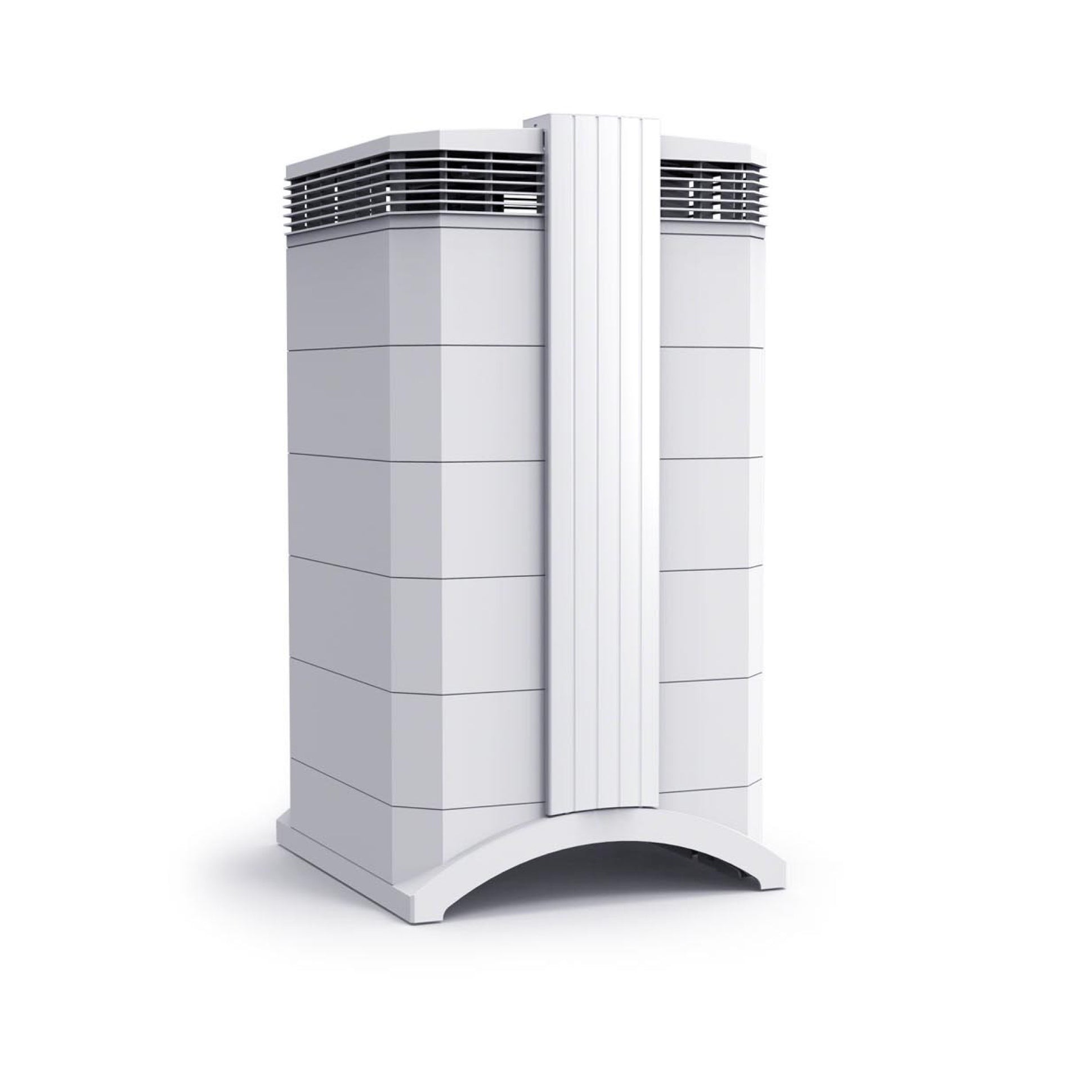
Strong EvidenceIQAir's HealthPro Plus is the closest thing to medical-grade filtration available for home use, used in hospitals and by allergists for patients with severe chemical sensitivity or immune compromise. Its HyperHEPA filtration captures particles down to 0.003 microns, far smaller than the 0.3-micron standard, and its gas/odor filter uses a substantial volume of activated carbon and other adsorbent media.
This level of performance comes at a steep price, both upfront ($900+) and in filter replacement costs, IQAir filters are more expensive and specific to the unit than most competitors' universal cartridges.
Who it's for: people with diagnosed allergies, asthma, chemical sensitivity, or immunocompromised household members where filtration performance genuinely justifies the premium. For a healthy adult just wanting general air quality improvement, it's likely overkill relative to cost.
- ·HyperHEPA filtration captures particles down to 0.003 microns
- ·Used clinically for allergy, asthma, and chemical sensitivity patients
- ·Price: $900+, with above-average filter replacement costs
- ·Best for: severe allergy/asthma/chemical sensitivity households
AirDoctor 5500 & Blueair Classic: Strong Mid-Tier Options
Moderate EvidenceAirDoctor's 5500 uses UltraHEPA filtration claiming capture down to 0.003 microns (competitive with IQAir's claims) at a meaningfully lower price point, combined with a dedicated carbon/VOC filter. It's a strong middle-ground choice for people who want near-clinical performance claims without IQAir's price tag, though independent third-party verification of the sub-HEPA claims is less extensive than IQAir's clinical track record.
Blueair's Classic line uses a proprietary electrostatic + HEPASilent technology that achieves high CADR at lower noise and energy consumption than mechanical-only HEPA units. Blueair is a solid pick for larger rooms or open-plan spaces where CADR and quiet operation both matter.
Both brands sit in the $300-$700 range depending on model size, meaningfully cheaper than IQAir while still offering true HEPA-equivalent or better filtration plus carbon/VOC capability.
- ·AirDoctor 5500: UltraHEPA + carbon/VOC filter, competitive with IQAir's particle claims at lower price
- ·Blueair Classic: HEPASilent technology, strong CADR-to-noise ratio, good for larger rooms
- ·Price range: $300-$700 depending on model
- ·Best for: strong performance without IQAir's clinical-tier price tag
Coway Airmega: The Value Pick
Moderate EvidenceCoway's Airmega line consistently ranks as the best value option in independent consumer testing, offering true HEPA filtration, solid CADR for its price class, and a real-time air quality indicator that gives immediate feedback without needing a separate monitor. It's a frequent 'best overall' pick in mainstream product reviews specifically because it doesn't oversell its capabilities.
Filter replacement costs are lower than IQAir and comparable to or cheaper than AirDoctor and Blueair, and the units are generally quieter than competitors at equivalent CADR output, a meaningful factor for bedroom placement.
Who it's for: most biohackers who want genuinely effective bedroom air filtration without paying a premium for clinical-grade claims they don't need. This is the default recommendation for someone asking 'just tell me what to buy.'
- ·True HEPA with strong CADR-to-price ratio
- ·Real-time built-in air quality indicator
- ·Lower filter replacement costs than premium competitors
- ·Best for: most bedroom use cases without chemical sensitivity or clinical needs
Buying by Need and Room Size
Standard bedroom, no diagnosed sensitivity: Coway Airmega, sized to your room's square footage. This covers the vast majority of biohackers wanting a straightforward air quality upgrade.
Larger bedroom or open-plan space: Blueair Classic, its HEPASilent technology scales CADR without the noise penalty of purely mechanical units at larger sizes.
Chemical sensitivity, new furniture off-gassing, or heavy VOC concerns: AirDoctor 5500 or IQAir HealthPro Plus, both prioritize gas-phase filtration alongside particulates.
Diagnosed asthma, severe allergies, or immunocompromised household: IQAir HealthPro Plus, the clinical performance and track record justify the premium when health outcomes are directly at stake.
Community Consensus
r/AirPurifiers and r/Allergies both consistently point first-time buyers toward Coway Airmega as the 'you can't go wrong' recommendation, with AirDoctor and Blueair as common upgrades for larger spaces. IQAir gets recommended specifically for medical-grade needs, rarely as a general first purchase given the price gap.
A recurring theme across both communities: buyers regret undersizing for their room more than any other purchase mistake, sized correctly, even the value-tier options perform well; undersized, even premium units struggle.
Filter replacement cost is the most common long-term complaint, several users recommend checking replacement filter pricing before purchase since it compounds significantly over 2-3 years of ownership.
As an Amazon Associate, Reo Tuku Iho Limited earns from qualifying purchases through Amazon links on this site. Full disclosure
Sources
Key references cited in this guide. Links open the original publication or abstract.
- Ambient and household air pollution and healthWorld Health Organization, 2024
- Associations of bedroom PM2.5, CO2, temperature, humidity, and noise with sleep: An observational actigraphy studySleep Health, 2023
- Environmental and Health Impacts of Air Pollution: A ReviewFrontiers in Public Health, 2020
- IQAir HealthPro Plus filtration specificationsIQAir, 2026
Continue Reading
 Tools & Equipment
Environmental Health: Air & Water Guide
You can't out-supplement a toxic environment. Indoor air quality, water contamination (PFAS, lead, chlorine), and EMF exposure are foundational biohacking concerns. This guide covers practical home upgrades ranked by impact and cost.
Read guide Tools & Equipment
Water Filtration: PFAS, Fluoride & Home Systems
Tap water quality varies dramatically by region — PFAS ('forever chemicals'), lead, chlorine, fluoride, and microplastics are documented in municipal supplies globally. Water filtration is foundational environmental health, not optional biohacking. This guide compares gravity filters, reverse osmosis, and pitcher systems by what they actually remove.
Read guideTools & EquipmentBest Water Filter for Biohackers: Berkey vs AquaTru vs Waterdrop Compared
Tap water carries PFAS, fluoride, lead, and microplastics — biohackers filter drinking water for the same reason they filter air. This guide compares Berkey gravity filters, AquaTru countertop reverse osmosis, and Waterdrop under-sink tankless RO by contaminant removal, installation, and cost. For the science on filter types and regional water quality, see our Water Filtration guide.
Read guide Sleep Optimization
Sleep Optimization: The Complete Guide
Sleep is the foundation every biohacker builds on, Huberman calls it the #1 performance enhancer. This guide covers the science of sleep stages, temperature regulation, light protocols, tracking with wearables, and the complete toolkit for deep restorative sleep.
Read guide Light Therapy
Best Red Light Therapy Panel for Home Use: A Biohacker's Buying Guide
Red light therapy (photobiomodulation) panels range from $150 travel-size units to $2,000+ full-body clinical panels, and price alone tells you almost nothing about effectiveness. What actually matters is irradiance at a realistic treatment distance, wavelength accuracy at 630–670nm (red) and 810–850nm (near-infrared), and whether the company publishes third-party testing. This guide compares Joovv's Elite panel, Hooga's budget-friendly HG panel, Mito Red's Mitopro line, and CurrentBody's LED mask for facial use, then breaks down how to choose based on your goals and budget. New to the science? Start with our Red Light Therapy complete guide.
Read guideLast updated: 2026-07-25 · For informational purposes only. Not medical advice. Consult a healthcare provider before starting any new health protocol. Health disclaimer.